
Tracking Research: Comprehensive Database of Studies on D.A.R.V.O
The field of study focusing on Deny, Attack, and Reverse Victim and Offender (D.A.R.V.O) is expanding. For those keen on understanding these subjects, we’ve put together a database of relevant studies.
About the DARVO Research Database
Currently, our DARVO research database (updated in August 2026 with articles through July 2026) includes 74 academic articles and papers. These cover various issues of interpersonal harm like sexual violence and racial violence, institutional harm in different settings like religious and judicial, and collective harm of broader societal beliefs and narratives pertaining to DARVO.
If you have questions about this page or would like to share newly published research on DARVO with us, please contact us at team@institutionalcourage.org
Goal:
The database helps researchers discover the existing published work that substantively relates to DARVO.
Our Process:
Inclusion Criteria: Our list comprises peer-reviewed articles or other published studies, books, chapters, news pieces, dissertations, theses, and when feasible, abstracts from conferences or academic posters. In each work, DARVO is either a variable, finding, focus, or is thematically important.
History: This is the initial version of the “DARVO Tracking Research” page, published in August 2026. At this time, we created the DARVO database with works through July 2026, with a current total of 74 articles.
Search Time-frame and Approach: The original search spanned from April-July 2026. We used the search string [“DARVO” OR “D.A.R.V.O” OR “Deny, Attack, and Reverse Victim and Offender”] in the following databases: Google Scholar and Psych Info.
Analysis: Data were gathered from publication abstracts, results, participant, and discussion sections as available and appropriate. We used Claude AI to assist with extracting data from each individual publication for efficiency. These data include the presence and types of interpersonal harm, institutional harm, and/or collective harm, whether or not DARVO is the focus, the broad method type, a summary of the method and variables, a summary of participant characteristics, a summary of results or thematic overview, the publication type, and a full citation. We also have a section to delineate whether publications or presentations were funded by Courage.
Notable Trends as of August 2026 (for articles through July 2026):
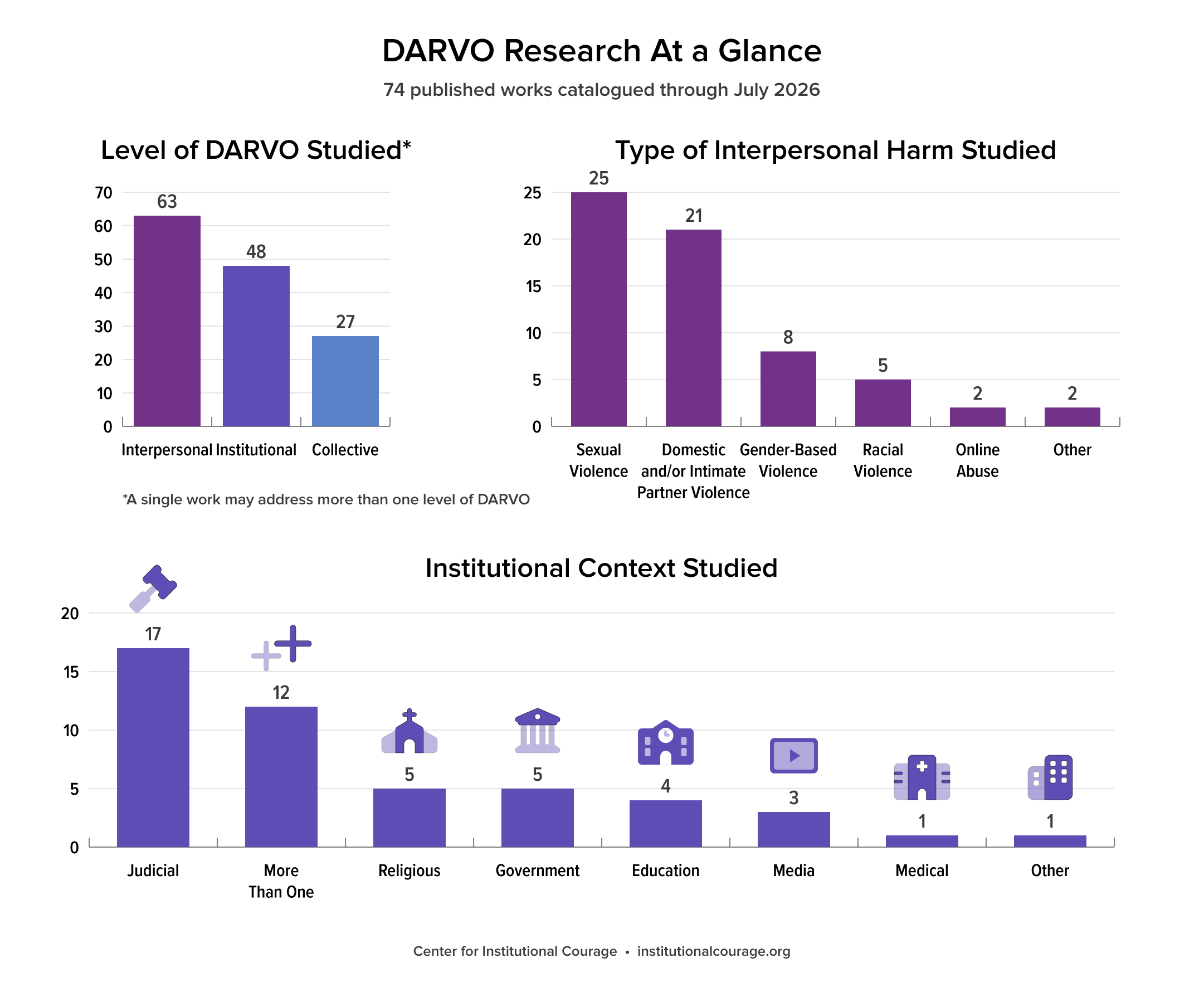
74 articles are entered into this current update.
Interpersonal, institutional, and collective harm occur simultaneously in 12 instances.
Trends in Interpersonal harm:
Sexual violence is the most studied interpersonal context of harm across the database, with 25 instances. This is closely followed by Domestic Violence and/or Intimate Partner Violence, with 21 instances.
The remaining types of harm (e.g. gender-based violence, racial violence, and online abuse) have been the focus of 8 or fewer studies, respectively.
There are two papers that focus on “other types of harm.”
Interpersonal harm occurs by itself (without co-occurring institutional and/or collective harm) in 18 instances.
Interpersonal with Institutional harm co-occur in 26 instances.
Interpersonal with Collective harm co-occur in 8 instances
Trends in Institutional harm:
Judicial is the most studied institutional context of harm across the database, with 17 instances.
There are 12 papers that focus on “more than one” types of institutional harm, being the second most common occurrence after judicial.
The remaining contexts of harm (e.g. religious, medical, education, government, media, and other) have been the focus of 5 or fewer studies, respectively,
Institutional harm occurs by itself in 3 instances.
Institutional with Collective harm co-occur in 5 instances.
There are currently 12 papers that focus on more than one context of institutional harm.
There is one paper that focused on “other types of harm.”
Trends in Collective Harm:
Collective harm occurs by itself in 2 instances.
Collective harm was treated as an exploratory category for the first DARVO database update; additional trends will be provided in the next update.
Trends in publication type:
Most papers are peer reviewed publications (33).
14 are book chapters, and 1 is a book.
10 are dissertations or theses.
4 are newsletter/ magazine articles/ or blog posts, 2 are editorials, and 3 are essays
2 are “other published studies,” indicating that they were published without being peer reviewed. 5 are “other” expert opinion papers, documents, book reviews, or law review articles.
Methodological trends:
7 studies are quantitative, 6 of which were cross-sectional.
17 studies are qualitative with a combination of cross-sectional and longitudinal study designs.
12 studies are mixed-methods, often combining quantitative and qualitative methods.
6 studies are meta-analyses, systematic, or other rigorous reviews.
7 studies are expert opinion, commentary, or perspective pieces.
14 studies are theoretical.
Fewer than 5 papers each utilize any of the remaining methods (e.g. experimental, case studies/case series, review of literature or specific work, training or intervention guide, other).