

April 2026
Dear Friends of Courage,
At a time when so many institutions are being tested, we are heartened by signs of courage, growth, and deepening scholarship across our field. We are especially excited to announce an update to our Research Tracking Database – we now have catalogued 527 articles about institutional betrayal and/or institutional courage published through 2025. Before sharing the latest insights from our Research Tracking Database, we are delighted to share some growth within our own institution. In the Fall of 2025, we welcomed a new research associate, Olivia Tobias, to the Center for Institutional Courage. A master’s student in the Psychological Sciences program at Northern Arizona University, Olivia is passionate about research that is relevant to Courage. Her support has been integral as we continue to navigate an increasing influx of published works in institutional betrayal and institutional courage.
We are also proud to celebrate recent recognition of members of the Courage team at the annual meeting of the International Society for the Study of Trauma & Dissociation (ISSTD). Courage Education Advisor Robyn L. Gobin, PhD, served as a plenary speaker. Courage Board Director and Chair of the Research Advisors Jennifer M. Gómez, PhD, was elected to Fellow status, and she participated on a plenary panel discussing institutional courage. Courage Affiliated Educator Shin Shin Tang, PhD, received an award for her book addressing institutional betrayal and institutional courage relevant to the psychology and psychotherapy of Asian Americans. And I was honored to receive the inaugural Courage Award. These recognitions reflect the growing reach and relevance of the ideas at the heart of Courage.
The first article in this issue, “Mapping the Field: 527 Articles, New Frontiers, and a LitMap,” by Aubrie Patterson, MS, and Olivia Tobias, BS, updates our Research Tracking Database. The authors highlight the field’s rapid growth, note emerging areas of inquiry, and introduce a new LitMaps-powered tool for visualizing this expanding body of research.
Our second article, “Burnout prevention is institutional courage,” by Monika Neff Lind, PhD and Alexis Adams-Clark, PhD, shows that institutional courage includes proactively supporting people doing demanding justice-oriented work. Drawing on dialectical behavior therapy and their work with frontline activists, the authors offer a framework for helping prevent burnout in the face of chronic stress and trauma.
We hope these articles inform, encourage, and challenge you. As always, thank you for your continued commitment to advancing institutional courage and thank you for your engagement,

Jennifer Freyd
Founder and President, Center for Institutional Courage
Mapping the Field: 527 Articles, New Frontiers, and a LitMap
Aubrie Patterson, M.S. & Olivia Tobias, B.S.
Northern Arizona University
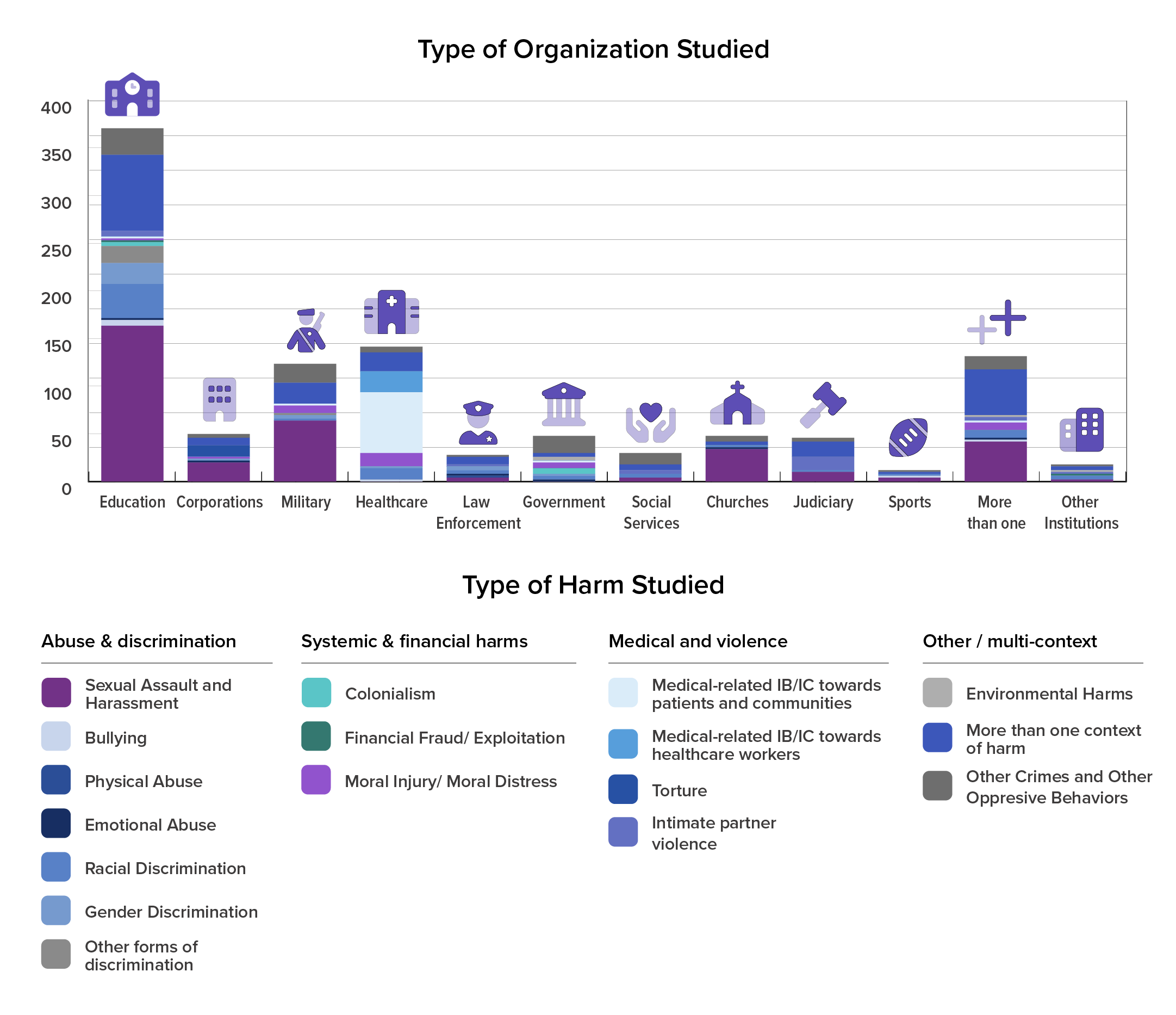
Research on institutional betrayal and institutional courage is exploding, in part because of the work of the Center for Institutional Courage. We are excited to announce a major update to our database on published research. We have catalogued the remaining 2025 literature that meets our inclusion criteria, where institutional betrayal or courage is a finding, focus, or key theoretical framework. This update adds nearly 200 additional articles to the Research Tracking Database, bringing us to a current total of 527.
In this update, we have noted a broadening of research into new institutional categories and contexts of harm. While Education continues to be the most prominent category with 186 papers, the data has necessitated creating two new institutional categories. The first is Social Services, which now includes 15 papers that have a focus on institutions such as child protective services and foster care. The second is Sports, with six papers investigating athletic institutions that are primarily centered on the Larry Nasser cases. Additionally, while Sexual Assault and Harassment continues to be our most prominent context of harm with 174 papers, we have identified three additional distinct contexts: Colonialism, Environmental Harms, and Emotional Abuse. These additions reflect an increasing interdisciplinary awareness of how betrayal and courage operate across diverse institutional systems and contexts.
We are also seeing a heartening shift toward research that situates institutional courage as a substantive focus. A standout example of this is Giuseppina Scotto di Carlo’s 2025 book, A Critical Discourse Analysis of Violence against Women: From D.A.R.V.O. to Institutional Courage. We have catalogued multiple chapters from this work, including “Institutional Courage and VAWG,” in which Scotto di Carlo reviews institutional responses to violence against women (VAWG) across 30+ global organizations. Based on her content analysis, the author concludes that institutional courage is a “muscle” that must be developed through structural change. She outlines concrete, courageous actions, such as conducting and publishing anonymous climate surveys, eliminating Non-Disclosure Agreements (NDAs) that silence survivors, and providing non-conditional support to reporters. For an institution to be truly courageous, she argues, it must treat a report of violence not as a threat to be managed, but as a "failure to be corrected."
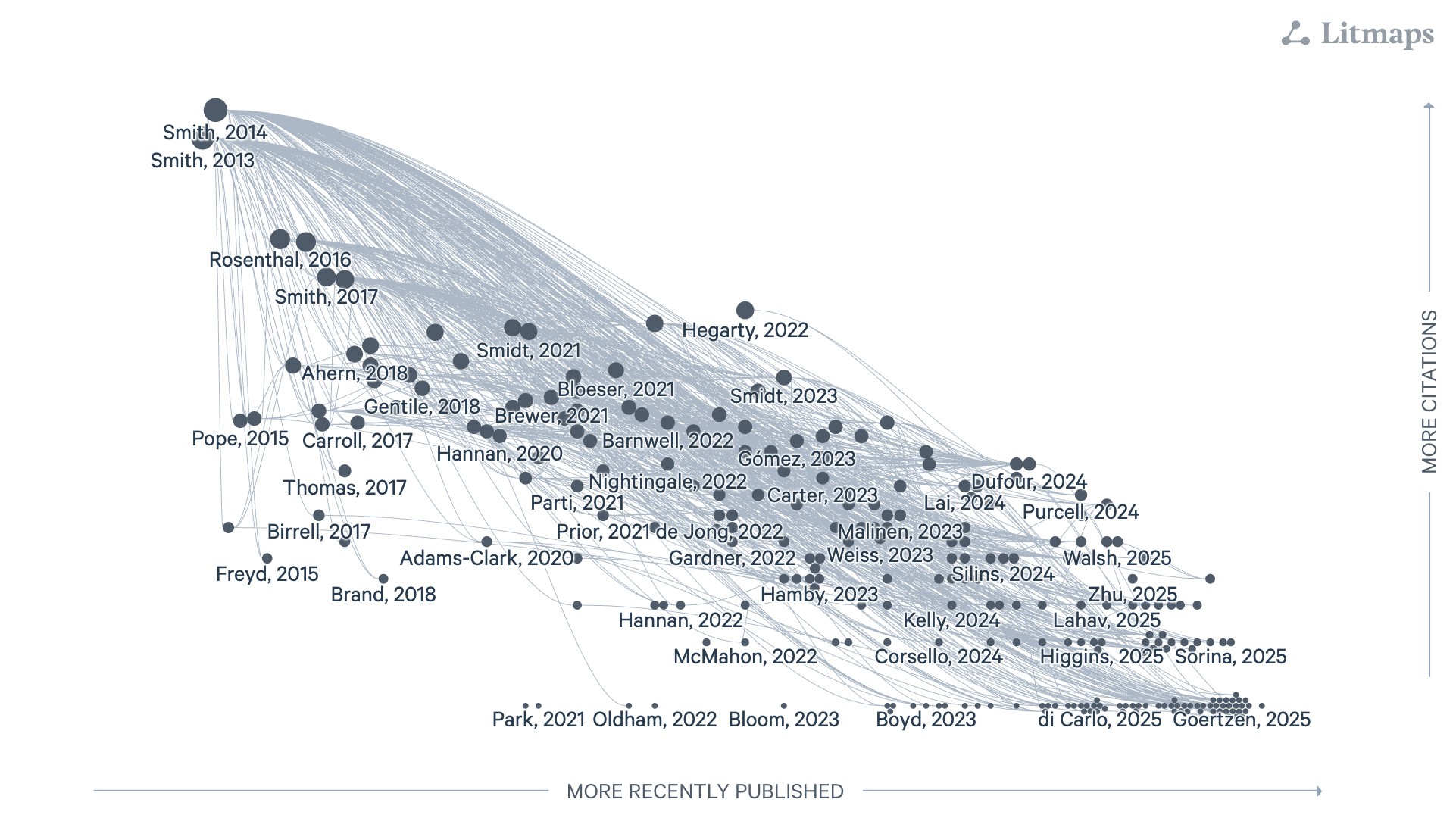
Finally, we have introduced a “State of the Field” tab to the database. This feature provides a visual depiction of patterns in citation volume over time for each peer-reviewed journal article that we have included in the database. We created this map using the AI platform LitMaps, and it is meant to quickly, visually demonstrate the state of the field for institutional betrayal and courage peer-reviewed research.
We thank you for all you do to further the cause of spreading awareness on institutional betrayal and institutional courage.
Join Us and Support Courage
With your help, Courage can conduct groundbreaking scientific research and share what we learn with the world. Together, we can make institutional courage a reality. Courage is a 501(c)(3) exempt organization, and your donation is deductible within the limits set by the IRS.

Burnout prevention is institutional courage
Monika Neff Lind, PhD & Alexis A. Adams-Clark, PhD
When political aggression toward immigrants, trans people, and disabled people in the US intensified in January 2025, we struggled with how to help. We called representatives, donated to progressive efforts, and attended rallies. Those actions were meaningful and rewarding, and we began thinking about how to leverage our clinical training to increase our impact. We determined that adopting a support role for frontline activists was our best option.
Activists pursue social change through actions such as protesting and community organizing. Social movements depend on activists’ ability to sustain these efforts over time. Burnout occurs when a passionate, dedicated person experiences mental, emotional, or physical exhaustion and loses their motivation. Activists may be especially vulnerable to burnout.
When activists work within social justice organizations, this vulnerability to burnout represents an opportunity for those organizations to demonstrate institutional courage. Progressive organizations ask their workers and volunteers to walk into a storm every day. Activist workers and volunteers face backlash, direct and vicarious trauma, and long hours. While the organization may not create these sources of chronic, severe invalidation, the organization must act with institutional courage and provide a buffer for workers and volunteers or else risk committing institutional betrayal.
Many progressive organizations are eager to provide such a buffer but struggle to implement effective programs. In the last year, we have developed an anti-burnout program for progressive organizations based on an effective, evidence-based treatment called dialectical behavior therapy (DBT). We chose to base our program on DBT for two reasons. First, DBT is practical and skill-based, which suits the busy schedules and problem-solving orientation of activists and progressive organizations. Second, DBT’s foundational theory parallels the development of activist burnout.
DBT’s biosocial theory of emotion dysregulation helps us understand activist burnout. The theory says that emotion dysregulation develops when people with heightened attunement to emotions spend a lot of time in invalidating environments during their youth. In activism, we propose that burnout develops when activists –people with heightened attunement to injustice– spend a lot of time in invalidating political and cultural environments. Understanding activist burnout through a biosocial lens suggests that DBT skills may help sustain activists’ efforts.
In May of 2025, we launched an initiative offering dialectical behavior coaching workshops to activists in partnership with nonprofit immigrant defense organizations. To date, we have conducted four workshops with two organizations, reaching 60+ full-time activists. Each session focused on applying specific DBT skills to the unique stressors of justice work within their organization, as described by attendees. While we emphasized that these workshops were not group therapy, participants shared experiences consistent with our biosocial conceptualization of burnout, including frustration with bureaucratic barriers, distress related to detailed accounts of violence experienced by clients, and pressure to maintain unsustainable workloads.
We are eager to continue this work, and we invite activists and organizations to reach out to us about collaborating. We have shared our insights and actions here in hopes that they will fuel more efforts.
Courage Team Links, News, and Events
Works by the Courage Team
Jennifer Freyd (Keynote address): From Betrayal to Courage
Sarah Harsey & Jennifer Freyd (Op-ed): Trump and Vance are using this abuser's tactic to rewrite a terrible crime
Warwick Middleton (Music album): I Want to Live Before I Die
Media Coverage about Courage and the Courage Team
Anne Deprince & Jennifer Freyd: Monica Lewinsky on the Epstein Files and the Nuances of Grooming
Jennifer Freyd: The Emotional Toll of Living With Institutional Betrayal
Jennifer Freyd: Betrayal Blindness: Oprah Daily Word of the Week