

Institutional Courage in Action – The position statement of the UK’s Royal College of Psychiatrists.
By Ashley Conway, PhD & Valerie Sinason, PhD
Something historic has just happened in the UK.
The Royal College of Psychiatrists (RCPsych) is the main professional organization of psychiatrists in the UK, and is responsible for representing psychiatrists, for psychiatric research and for providing public information about mental health problems. The college provides advice to those responsible for training and certifying psychiatrists in the UK.
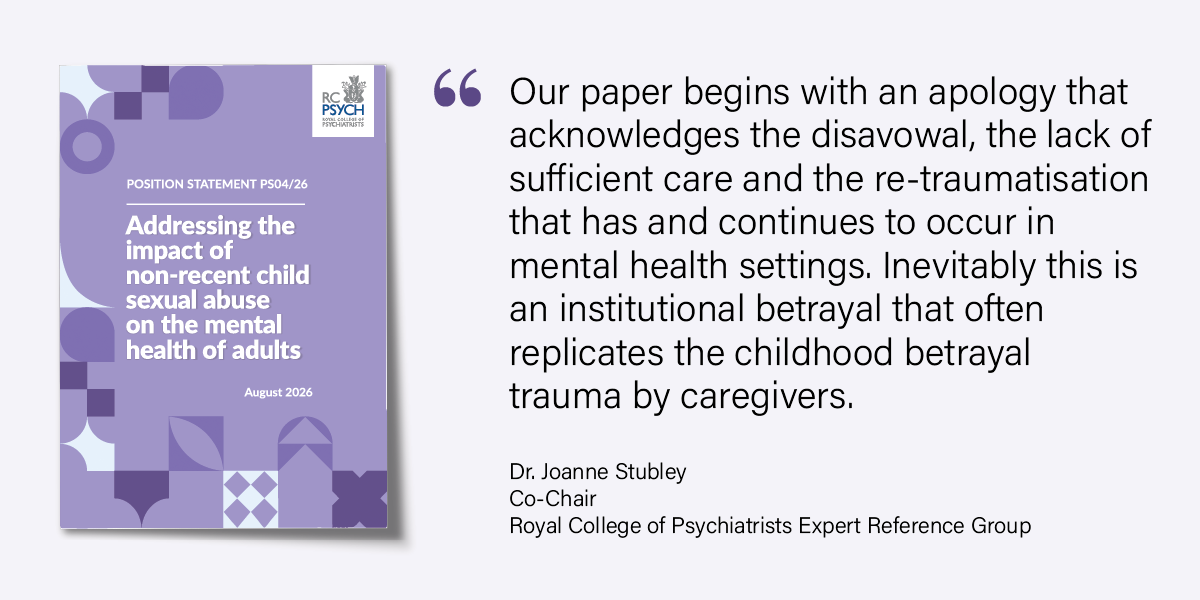
RCPsych has just published a position statement regarding the impact of childhood trauma on adult life: “Addressing the impact of non-recent child sexual abuse of adults”. One of the steps of nurturing institutional courage suggested by the Center for Institutional Courage is “Bear witness, be accountable, apologize”. This new position paper by RCPsych demonstrates exactly this kind of courage.
Dr Joanne Stubley one of the co-authors of the RCPsych document explained to us- “Our paper begins with an apology that acknowledges the disavowal, the lack of sufficient care and the re-traumatisation that has and continues to occur in mental health settings. Inevitably this is an institutional betrayal that often replicates the childhood betrayal trauma by caregivers. It is hoped that in the acknowledgement of this we have a beginning of reparation but now the real work begins to change this within the system.”
The careful mixture of attention to survivors, survivor professionals, professionals and researchers makes for a rich and profoundly meaningful apology. In our lifelong areas of work we were particularly pleased that dissociation and dissociative disorders were properly recognized rather than the usual psychiatric dismissal.
Additionally, our concerns about claims of “false memory syndrome” (FMS) were validated. The False Memory Syndrome Foundation was formed in the USA in 1992 by parents who claimed to be falsely accused of child sexual abuse. FMS, as the position paper emphasises, is not a real syndrome and was aimed to pathologize the memory of survivors and the work of their therapists. The False Memory Syndrome model arrived in the UK a couple of years later, also initiated by someone accused of child sexual abuse (see Sinason,V. Ed., 1998, Memory in Dispute, London:Karnac).
The Position Paper shares our views that survivors commonly present with histories that are fragmented, inconsistent or confused. They may be unable to verbally recall the event(s) or only experience somatic sensations connected to the abuse. They may recover the memories of child sexual abuse as an adult in what is often a disturbing, discontinuous and fragmented experience, and this may occur while in treatment for physical and mental health conditions. The subject of our last co-edited book Trauma and Memory, The Science and the Silenced dedicated to Courage Founder and President Jennifer Freyd, was referenced.
There are many gifts in the Position Paper and it can be accessed for free. Thousands of survivors, scientists and mental health professionals have been fighting attacks on the veracity of abuse for decades, all feeling alone. That loneliness has also been present for the pioneers. Hopefully the triumph of this paper will lead to further breakthroughs. Congratulations to Dr Jo Stubley, Maria Podlejska-Eyres, and their team for their remarkable institutional courage, after years of researching how to stop further iatrogenic damage to survivors and congratulations to the Royal College of Psychiatry for their bravery in publishing this crucial paper. This is indeed institutional courage all round.
Join Us and Support Courage
With your help, Courage can conduct groundbreaking scientific research and share what we learn with the world. Together, we can make institutional courage a reality. Courage is a 501(c)(3) exempt organization, and your donation is deductible within the limits set by the IRS.