

Join Us and Support Courage
With your help, Courage can conduct groundbreaking scientific research and share what we learn with the world. Together, we can make institutional courage a reality. Courage is a 501(c)(3) exempt organization, and your donation is deductible within the limits set by the IRS.
New DARVO Research Tracking Database: With 74 articles
By Olivia Tobias, B.S. & Aubrie Patterson, M.S.
Northern Arizona University
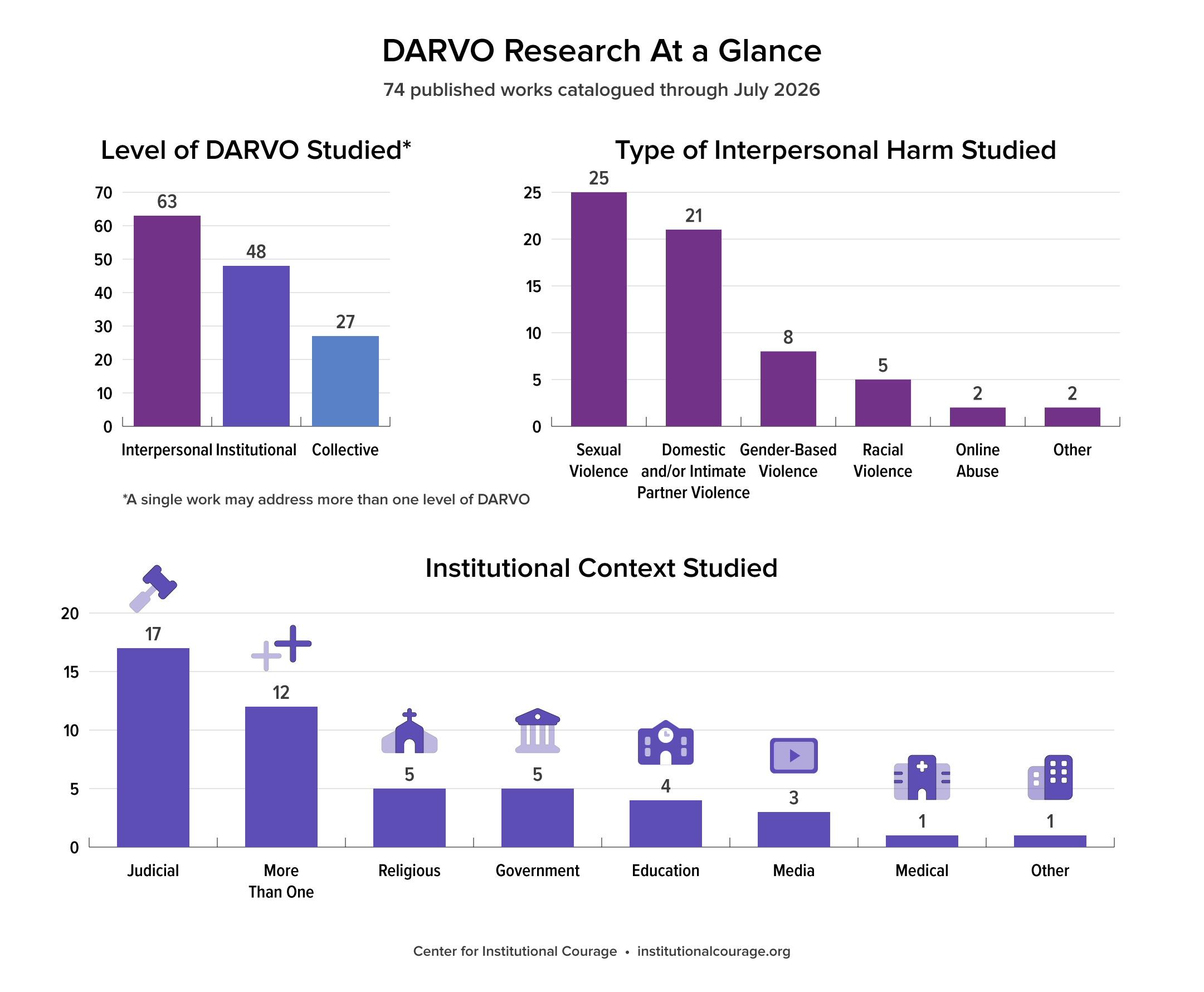
Alongside the ever-growing institutional betrayal and courage tracking database, cataloguing research on DARVO (Deny, Attack, and Reverse Victim and Offender) has been a major focus for the Center for Institutional Courage in 2026. We are excited to announce a brand-new database dedicated to published literature on DARVO. In this database, we have catalogued all scholarship through July 2026 that meets our inclusion criteria: specifically, studies where DARVO serves as a variable, finding, focus, or theoretical framework. This inaugural release contains 74 articles in the DARVO tracking database.
Within the new database, we have categorized DARVO research into three, oftentimes overlapping, contexts of harm: interpersonal, institutional, and collective harm. Interpersonal harm is the most prominent context of harm with 63 papers, followed by institutional harm with 48 papers, and collective harm with 27 papers. Additionally, interpersonal and institutional harm co-occur 39 times, interpersonal and collective harm co-occur 20 times, institutional and collective harm co-occur 19 times, and all three harm types occur together 14 times. Within interpersonal harm type, subcategories include sexual violence (25), domestic violence and/or intimate partner violence (21), gender-based violence (8), racial violence (5), online abuse (2), and other (2). Institutional harm contexts include judicial (17), more than one (12), government (5), religious (5), education (4), media (3), medical (1), and other (1). Finally, emerging patterns of collective harm in the DARVO literature include sociocultural beliefs surrounding sexual harassment, violence against women and girls, and rape culture.
Based on our observations of the current DARVO database, the primary focus of contemporary DARVO literature centers on sexual, domestic, and intimate partner violence within judicial contexts. Broadly, this scholarship explores how both individual perpetrators of violence, and the judicial institutions involved in such cases, systematically undermine and invalidate abuse allegations. A notable example is Adrienne Barnett’s 2024 expert paper written for the FiLiA Hague Mothers’ Campaign, Domestic Violence, Parental Alienation, and Perpetrator Tactics in Court Proceedings. Barnett demonstrates how perpetrators leverage DARVO strategies during family court proceedings involving domestic violence to discredit victims, frequently resulting in the transfer of child custody to abusive parents. One of our preliminary observations across this area of research is that as perpetrators increasingly secure favorable legal outcomes through DARVO, these victories compound to reinforce harmful sociocultural myths surrounding abuse. Consequently, the legal framework becomes an instrument for silencing survivors, inflicting collective harm as perpetrator narratives permeate in legal and public spheres.
Despite the many instrumental advances to DARVO scholarship over the past few decades, significant gaps remain. For example, harm types and contexts including media, medical settings, and online abuse remain relatively under-studied. Similarly, further empirical work is needed to examine how DARVO intersects with racism given we only catalogued 5 papers on racial violence compared to the 25 papers on sexual violence.
We hope the new DARVO database serves as a resource for scholars, mental health professionals, and legal advocates. We invite you to explore the database, study the current gaps in DARVO scholarship, and join us in our ongoing mission to replace harmful acts like DARVO with institutional courage.