


October 2026
Dear Friends of Courage,
Institutional betrayal is at the center of the recent, intensely discussed case of the alleged gang rape at Cornell University. How can law enforcement and university administrators demonstrate institutional courage now? Our suggested steps for nurturing institutional courage offer a starting place. Apologies are warranted and would go a long way toward healing. Education, authentic, meaningful, and deep, is at the heart of the higher education mission and should be provided. And institutions must cherish whistleblowers and resist defensive reactions such as DARVO.
DARVO stands for Deny, Attack, and Reverse Victim & Offender. I introduced the term in a 1997 publication, and this year Merriam-Webster added the word DARVO to its dictionary. That recognition shows how widely the pattern is now understood, and how much remains to be learned about it.
Both themes, institutions acknowledging harm and the growing scholarship on DARVO, run through this issue of The Courage Brief. We are pleased to share a powerful example of an institution publicly acknowledging past harm, and a new resource for understanding research on DARVO.
Our first article, “Institutional Courage in Action – The position statement of the UK’s Royal College of Psychiatrists,” by Ashley Conway, PhD, and Valerie Sinason, PhD, examines a new position statement from the Royal College of Psychiatrists addressing the lasting impact of childhood sexual abuse. The authors describe the statement—and particularly its acknowledgment of institutional failures and apology to survivors—as a meaningful example of institutional courage in action.
Our second article, “New DARVO Research Tracking Database: With 74 articles,” by Olivia Tobias, BS, and Aubrie Patterson, MS, introduces the Center for Institutional Courage’s new database of published DARVO research. The authors highlight patterns across interpersonal, institutional, and collective forms of harm, while also identifying important gaps and opportunities for future research.
We hope these articles inform, encourage, and challenge you. As always, thank you for your continued commitment to advancing institutional courage and thank you for your engagement,

Jennifer Freyd
Founder and President, Center for Institutional Courage
Institutional Courage in Action – The position statement of the UK’s Royal College of Psychiatrists.
By Ashley Conway, PhD & Valerie Sinason, PhD
Something historic has just happened in the UK.
The Royal College of Psychiatrists (RCPsych) is the main professional organization of psychiatrists in the UK, and is responsible for representing psychiatrists, for psychiatric research and for providing public information about mental health problems. The college provides advice to those responsible for training and certifying psychiatrists in the UK.
RCPsych has just published a position statement regarding the impact of childhood trauma on adult life: “Addressing the impact of non-recent child sexual abuse of adults”. One of the steps of nurturing institutional courage suggested by the Center for Institutional Courage is “Bear witness, be accountable, apologize”. This new position paper by RCPsych demonstrates exactly this kind of courage.
Dr Joanne Stubley one of the co-authors of the RCPsych document explained to us- “Our paper begins with an apology that acknowledges the disavowal, the lack of sufficient care and the re-traumatisation that has and continues to occur in mental health settings. Inevitably this is an institutional betrayal that often replicates the childhood betrayal trauma by caregivers. It is hoped that in the acknowledgement of this we have a beginning of reparation but now the real work begins to change this within the system.”
The careful mixture of attention to survivors, survivor professionals, professionals and researchers makes for a rich and profoundly meaningful apology. In our lifelong areas of work we were particularly pleased that dissociation and dissociative disorders were properly recognized rather than the usual psychiatric dismissal.
Additionally, our concerns about claims of “false memory syndrome” (FMS) were validated. The False Memory Syndrome Foundation was formed in the USA in 1992 by parents who claimed to be falsely accused of child sexual abuse. FMS, as the position paper emphasises, is not a real syndrome and was aimed to pathologize the memory of survivors and the work of their therapists. The False Memory Syndrome model arrived in the UK a couple of years later, also initiated by someone accused of child sexual abuse (see Sinason,V. Ed., 1998, Memory in Dispute, London:Karnac).
The Position Paper shares our views that survivors commonly present with histories that are fragmented, inconsistent or confused. They may be unable to verbally recall the event(s) or only experience somatic sensations connected to the abuse. They may recover the memories of child sexual abuse as an adult in what is often a disturbing, discontinuous and fragmented experience, and this may occur while in treatment for physical and mental health conditions. The subject of our last co-edited book Trauma and Memory, The Science and the Silenced dedicated to Courage Founder and President Jennifer Freyd, was referenced.
There are many gifts in the Position Paper and it can be accessed for free. Thousands of survivors, scientists and mental health professionals have been fighting attacks on the veracity of abuse for decades, all feeling alone. That loneliness has also been present for the pioneers. Hopefully the triumph of this paper will lead to further breakthroughs. Congratulations to Dr Jo Stubley, Maria Podlejska-Eyres, and their team for their remarkable institutional courage, after years of researching how to stop further iatrogenic damage to survivors and congratulations to the Royal College of Psychiatry for their bravery in publishing this crucial paper. This is indeed institutional courage all round.
Join Us and Support Courage
With your help, Courage can conduct groundbreaking scientific research and share what we learn with the world. Together, we can make institutional courage a reality. Courage is a 501(c)(3) exempt organization, and your donation is deductible within the limits set by the IRS.
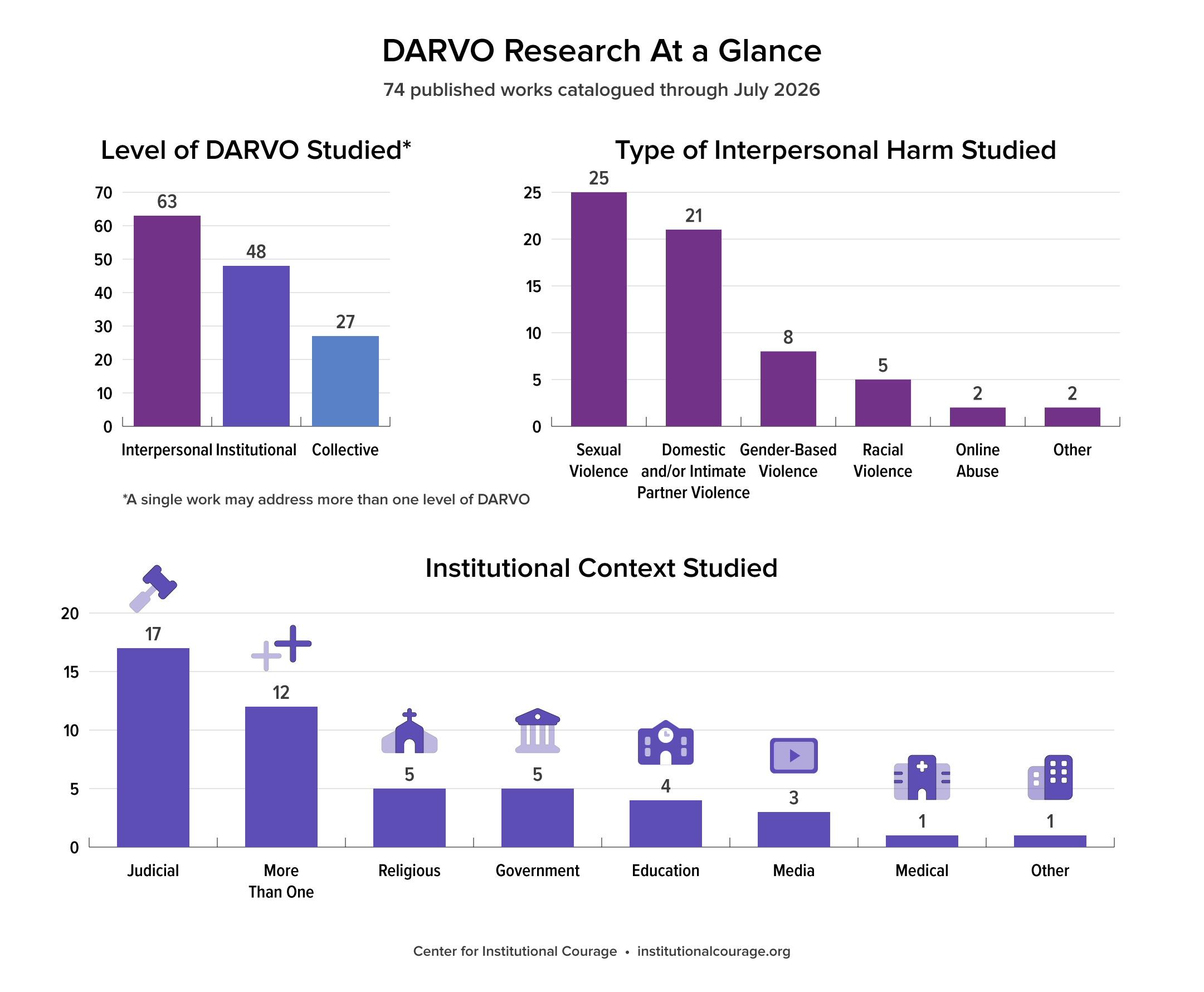
New DARVO Research Tracking Database: With 74 articles
By Olivia Tobias, B.S. & Aubrie Patterson, M.S.
Northern Arizona University
Alongside the ever-growing institutional betrayal and courage tracking database, cataloguing research on DARVO (Deny, Attack, and Reverse Victim and Offender) has been a major focus for the Center for Institutional Courage in 2026. We are excited to announce a brand-new database dedicated to published literature on DARVO. In this database, we have catalogued all scholarship through July 2026 that meets our inclusion criteria: specifically, studies where DARVO serves as a variable, finding, focus, or theoretical framework. This inaugural release contains 74 articles in the DARVO tracking database.
Within the new database, we have categorized DARVO research into three, oftentimes overlapping, contexts of harm: interpersonal, institutional, and collective harm. Interpersonal harm is the most prominent context of harm with 63 papers, followed by institutional harm with 48 papers, and collective harm with 27 papers. Additionally, interpersonal and institutional harm co-occur 39 times, interpersonal and collective harm co-occur 20 times, institutional and collective harm co-occur 19 times, and all three harm types occur together 14 times. Within interpersonal harm type, subcategories include sexual violence (25), domestic violence and/or intimate partner violence (21), gender-based violence (8), racial violence (5), online abuse (2), and other (2). Institutional harm contexts include judicial (17), more than one (12), government (5), religious (5), education (4), media (3), medical (1), and other (1). Finally, emerging patterns of collective harm in the DARVO literature include sociocultural beliefs surrounding sexual harassment, violence against women and girls, and rape culture.
Based on our observations of the current DARVO database, the primary focus of contemporary DARVO literature centers on sexual, domestic, and intimate partner violence within judicial contexts. Broadly, this scholarship explores how both individual perpetrators of violence, and the judicial institutions involved in such cases, systematically undermine and invalidate abuse allegations. A notable example is Adrienne Barnett’s 2024 expert paper written for the FiLiA Hague Mothers’ Campaign, Domestic Violence, Parental Alienation, and Perpetrator Tactics in Court Proceedings. Barnett demonstrates how perpetrators leverage DARVO strategies during family court proceedings involving domestic violence to discredit victims, frequently resulting in the transfer of child custody to abusive parents. One of our preliminary observations across this area of research is that as perpetrators increasingly secure favorable legal outcomes through DARVO, these victories compound to reinforce harmful sociocultural myths surrounding abuse. Consequently, the legal framework becomes an instrument for silencing survivors, inflicting collective harm as perpetrator narratives permeate in legal and public spheres.
Despite the many instrumental advances to DARVO scholarship over the past few decades, significant gaps remain. For example, harm types and contexts including media, medical settings, and online abuse remain relatively under-studied. Similarly, further empirical work is needed to examine how DARVO intersects with racism given we only catalogued 5 papers on racial violence compared to the 25 papers on sexual violence.
We hope the new DARVO database serves as a resource for scholars, mental health professionals, and legal advocates. We invite you to explore the database, study the current gaps in DARVO scholarship, and join us in our ongoing mission to replace harmful acts like DARVO with institutional courage.
Courage Team Links, News, and Events
Works by the Courage Team
Alexis Adams-Clark, Melissa Barnes, Monika Lind, Alec Smidt & Jennifer Freyd (Research Article): Institutional courage attenuates the association between institutional betrayal and trauma symptoms among campus sexual assault survivors
Melissa Durland, Sarah Harsey & Jennifer Freyd (Research Article): Assessing Perpetrator Responses to Confrontation: Associations with a DARVO-SF and Posttrauma Symptoms in Two Different Populations
Alexis Adams-Clark & Jennifer Freyd (Research Article): Contextual Factors Associated with Posttraumatic Stress Among Campus Sexual Assault Survivors
Christianne Corbett, Meghan Warner, Sarah Harsey & Jennifer Freyd (Research Article): Sexual harassment at work: Targets’ perspectives on prevention and response
Media Coverage about Courage and the Courage Team
Jennifer Freyd: Do fraternities fuel sexual assaults on campus?
Jennifer Freyd: Prominent Salk Institute biologist to resign following sexual misconduct investigation
Jennifer Freyd: Cornell rape case exposes sexual violence at US colleges
Jennifer Freyd: Cornell case: an ‘institutional betrayal’ of victims in the post #MeToo era
For more Courage in the news see our live tracking page.